Julien Charbonnier and Yasmin Kanhoush
Archaïos
Oases are among the most fascinating and resilient human-made landscapes in the world. Nestled in the heart of arid regions, they have served as settlement points and vital hubs on caravan routes for millennia. These constructed landscapes have enabled sedentary life in desert environments. Despite their importance, our understanding of oases—particularly their spatial organization, evolution, and role in broader social and economic networks—remains limited. The AlUla Cultural Oasis Project (UCOP), conducted between 2019 and 2025, led by Julien Charbonnier and Yasmin Kanhoush aims to fill these gaps by exploring the al-ʿUlā Oasis in northwestern Saudi Arabia. See Figure 25. This project is the first of its kind to study a still-cultivated oasis in Arabia, offering a unique opportunity to understand how these landscapes have evolved over time.
UCOP is a collaborative effort led by Archaïos. It is funded and steered by the French Agency for AlUla Development (AFALULA) on behalf of the Royal Commission for AlUla (RCU). The interdisciplinary project brings together archaeologists, geographers and architects. Fieldwork involved ten seasons of surveys and excavations which took place between 2019 and 2024.
The AlUla Cultural Oasis Project was designed to address two major blind spots in the archaeology of Arabian oases:
- While much research has focused on pre-Islamic oases, the Islamic Period (from the 7th century AD onward) remains poorly documented. UCOP seeks to reconstruct the history of al-ʿUlā during this era, particularly from the 13th to the 19th centuries AD, a period known almost exclusively through travelers’ accounts and historical texts.
- Previous studies have primarily examined oases through their agricultural and water systems, or as nodes within commercial networks. UCOP shifts the focus to the internal organization of oases, analyzing how land parcels, water distribution networks, domestic architecture, and circulation systems have shaped (and in turn been shaped by) social, economic, and environmental factors.
By adopting a spatial approach, UCOP treats the oasis not just as an agricultural unit but as a dynamic social and historical space. The project aims to document the oasis’s evolution, from its earliest settlements to its modern challenges.
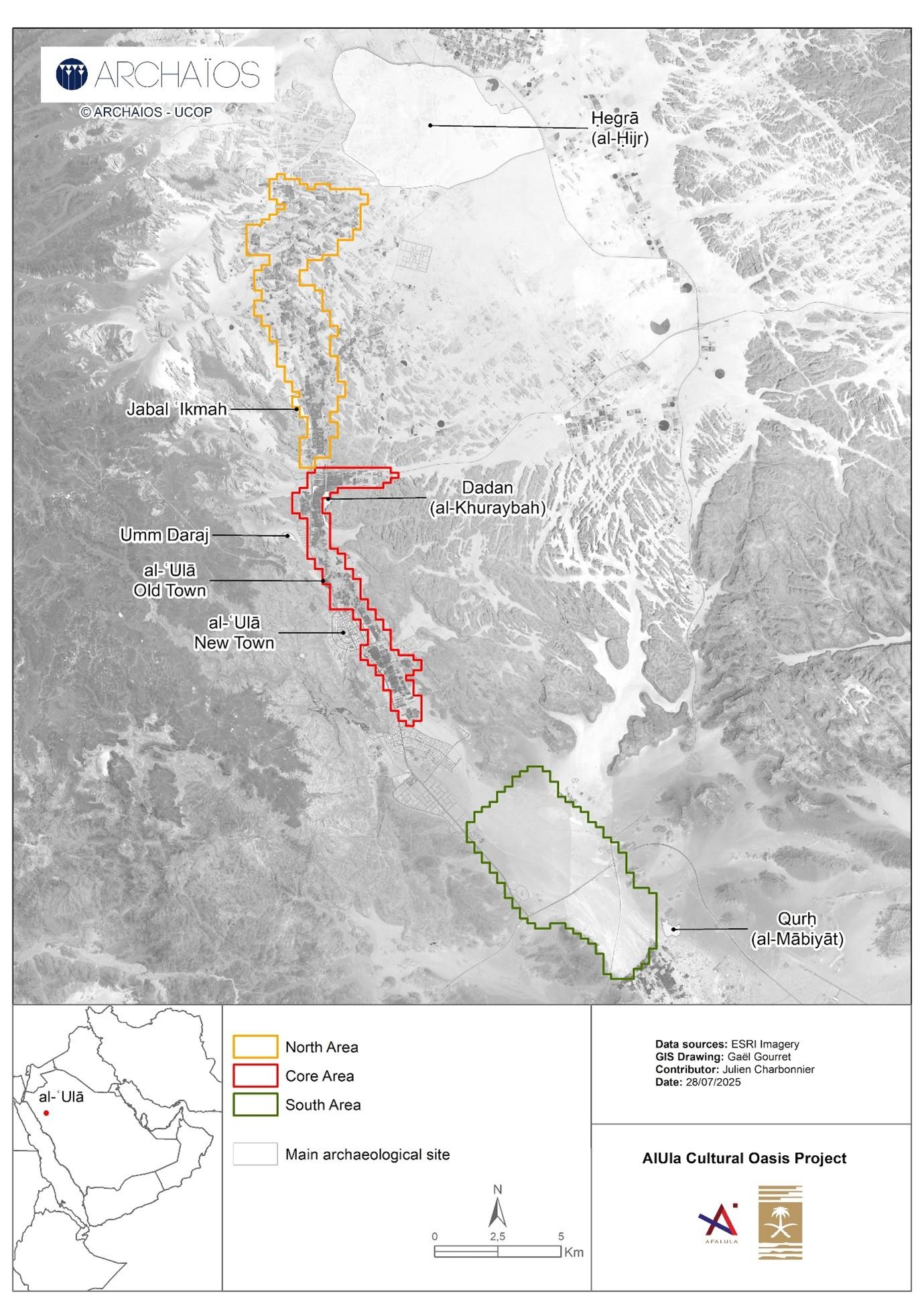
Figure 25. Location of the al-ʿUlā Oasis and project study areas in the valley. Map ©Archaïos.
Study Area: The al-ʿUlā Valley (Saudi Arabia)
The al-ʿUlā Oasis is located in the northern Ḥijāz region of Saudi Arabia, approximately 280 km northwest of Medina and 240 km southeast of Tabuk. The oasis lies in a narrow valley which runs north-south and is surrounded by sandstone escarpments and basaltic plateaus. The valley’s elevation ranges from 650 to 770 meters above sea level. See Figure 26.
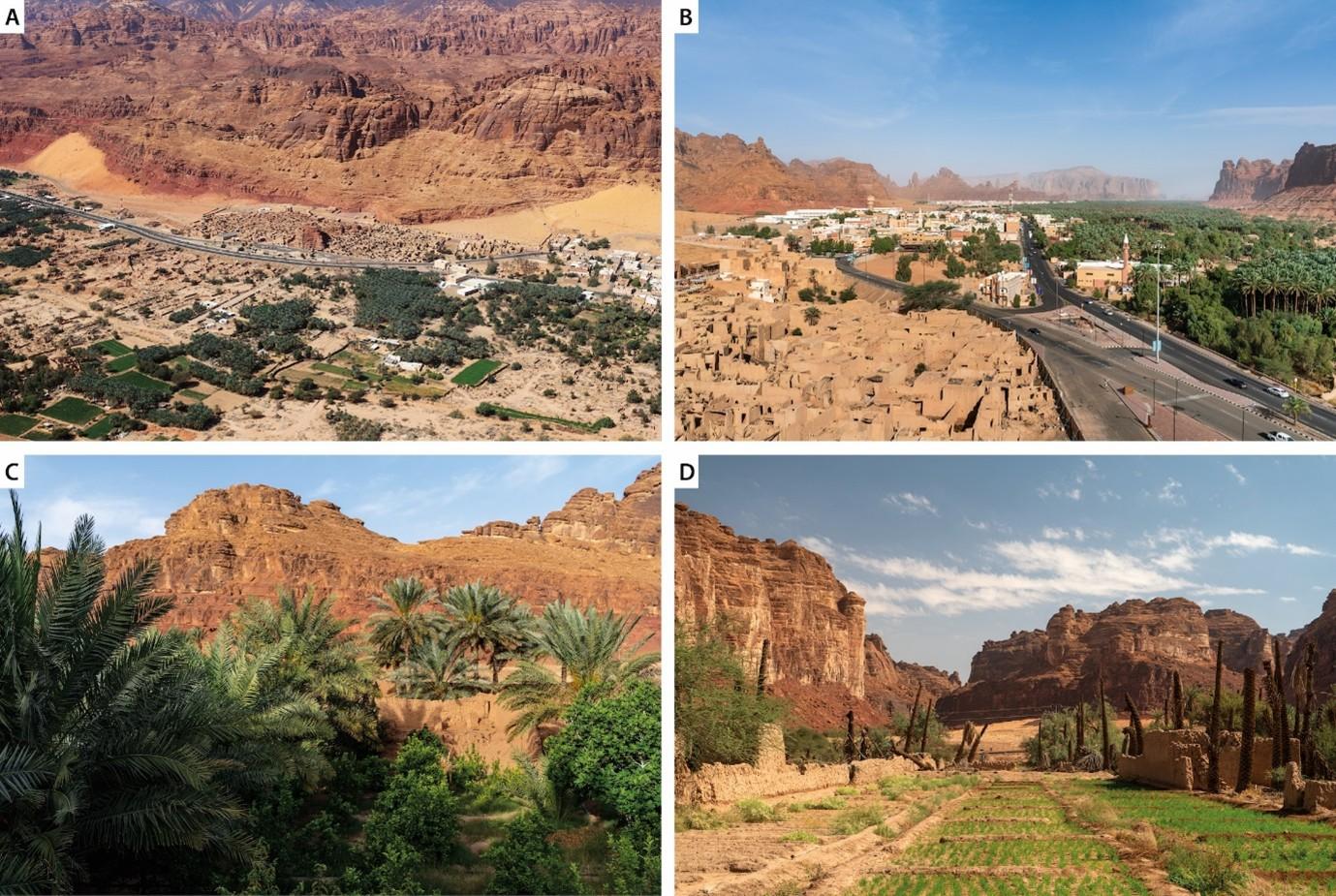
Figure 26. A: The al-ʿUlā Old Town nestled along the cliffs to the west of the valley. Image by J. Charbonnier; B: The palm grove and al-Jadīdah district seen from the Old Town. Image by S. Sepeau; C: Horticultural gardens in the historical core of the palm grove. Image by S. Sepeau; D: Plot returned to cultivation in the historical core of the palm grove. Image by S. Sepeau; ©Archaïos.
The al-ʿUlā Valley has a long history as a crossroads for trade and pilgrimage. It was home to the ancient city of Dadan, a major political and economic center during the 1st millennium BC, and later to Madāʾin Ṣāliḥ (ancient Ḥegrā), which flourished under the Nabataeans. During the Islamic Period, the valley became a key stopover on the Syrian pilgrimage route, connecting the Levant to the holy cities of Mecca and Medina. The Town of al-ʿUlā became the main settlement of the valley after the abandonment of the city of al-Mābiyāt (ancient Qurḥ), during the 12th century AD. Despite its historical significance, the oasis’s internal organization and evolution during the Islamic Period have remained largely unexplored, until now.
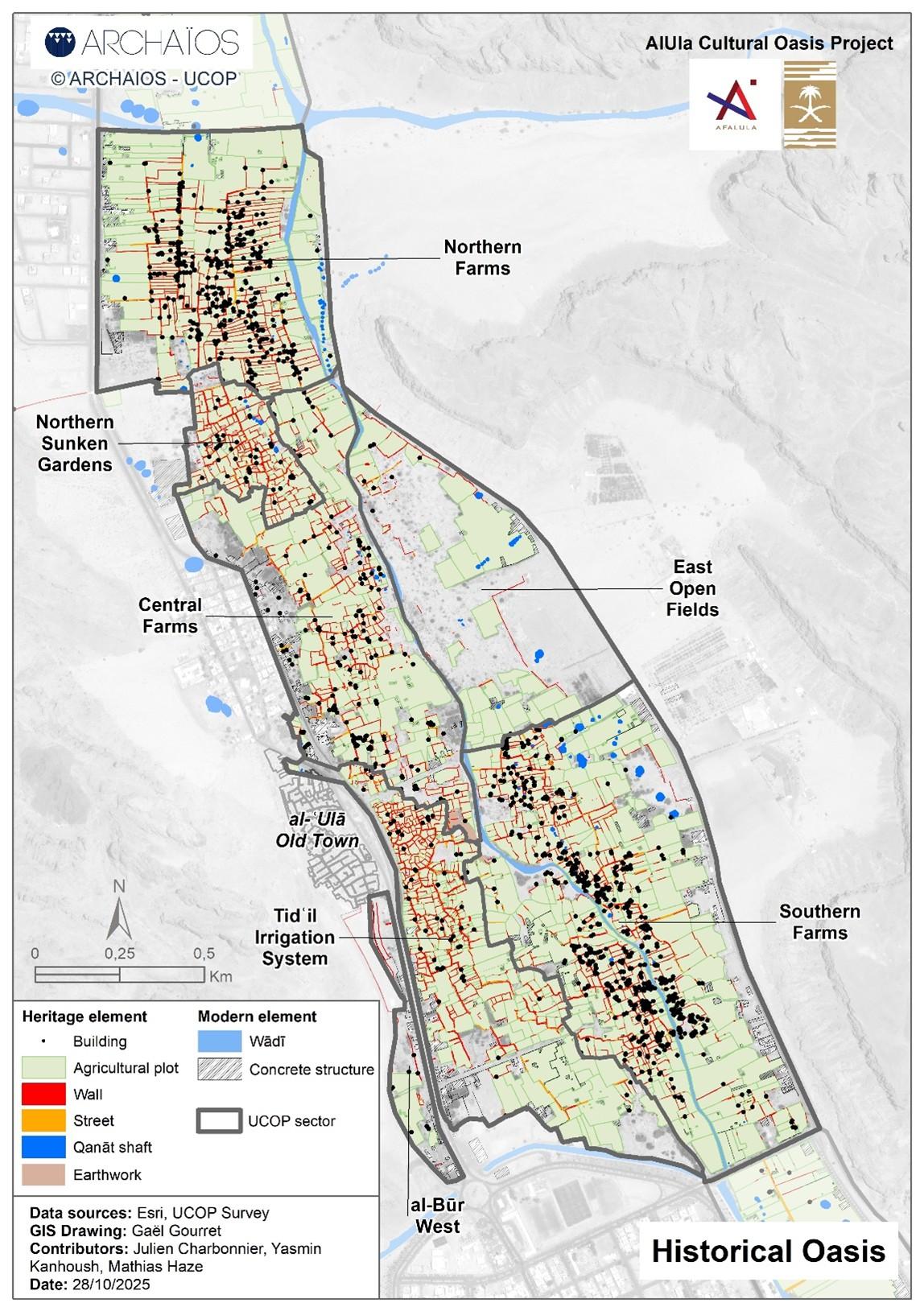
Figure 27. Archaeological map of the central part of al-ʿUlā Oasis (core area of study). Map ©Archaïos.
A Multidisciplinary Approach
UCOP employed a multidisciplinary methodology to document and analyze the al-ʿUlā Oasis:
- Pedestrian surveys: Systematic fieldwalking was done across 4,000 hectares of cultivated and abandoned agricultural plots to record archaeological structures, heritage features, and to collect material remains. This fieldwork resulted in the creation of the first detailed archaeological map of an oasis in Arabia. See Figure 27.
- Aerial and satellite imagery: Analysis of archived and modern imagery was used to track changes in the oasis’s landscape over time, particularly since the 1960s.
- Building archaeology: The project undertook detailed recording of domestic and defensive structures, including perimeter walls, vernacular dwellings (Figure 28), and towers.
- Water systems: Analysis of water catchment (qanats and wells) as well as irrigation systems inside the palm grove (channels and water distributors) was also made.
- Material culture analysis: Studies of ceramics, glass, and tobacco pipes were undertaken to better understand trade networks, economic activities, and cultural exchanges.
- Spatial analysis: Survey data was integrated into a geodatabase to analyze parcel morphology, circulation networks and the distribution of artefacts across the palm grove.
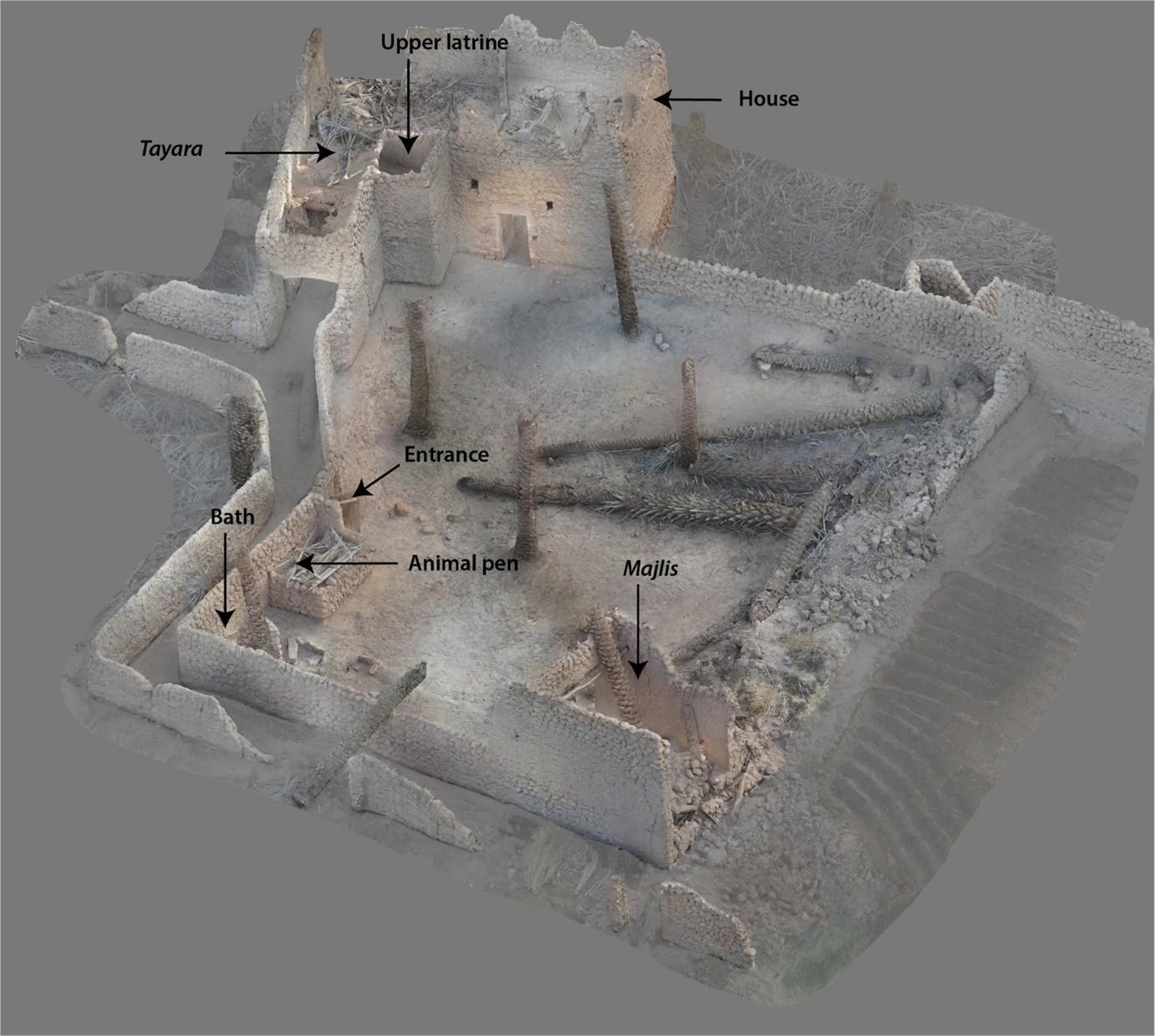
Figure 28. 3D view of an oasis farm, showing the layout of the buildings around the plot. Image ©Archaïos.
Why UCOP matters: Advancing oases studies
The AlUla Cultural Oasis Project demonstrates that al-ʿUlā was not a passive stopover on trade and pilgrimage routes. Rather, it was a complex socio-economic landscape throughout the Islamic and Ottoman periods.
UCOP’s multidisciplinary approach offers a holistic model for studying oases. By placing spatial organization at the core of analysis, the project significantly renews the archaeology of oases and offers a transferable methodological framework for future research on oasis landscapes in arid regions.
The results of the project are currently being published in a scientific monograph that will soon be submitted to a publishing house. This book presents a chronology of the oasis, from the Hegira to the present day. It shows that the oasis underwent constant redevelopment in response to particularly changing trade routes and successive political powers in the Middle East, whose influence was felt in spite of the region’s apparent isolation. The oasis has, thus, remained connected to long-distance trade networks extending as far as East Asia throughout its history (including between the 12th and the 19th century AD, a period that has been very poorly documented until now). Our work also demonstrates the role of the social organization of the population of the al-ʿUlā Oasis—which is divided into two main groups—in the spatial structuring of the palm grove, particularly in terms of the layout of circulation networks and the distribution of dwellings.
The project’s insights into traditional water management and land use also provide valuable lessons for modern sustainability efforts. It highlights the importance of sharing qanat water for the sustainability of the oasis. Conversely, the introduction of new pumping techniques in the mid-20th century (i.e., the diesel-powered pumps which were progressively replaced by drilled wells and electric submersible pumps) marked the transition from community-based and relatively sustainable groundwater management to their “mining exploitation” through individual installations. This has made it possible to significantly expand cultivated areas, but it also caused the rapid lowering of the water table, which led to the complete drying-out and abandonment of qanats in the 1970s-1980s. Our archaeological approach allows us to identify these changes on a fine scale, demonstrating the role of this discipline in understanding contemporary dynamics. By documenting how past communities thrived in arid environments, UCOP thus contributes to contemporary discussions on water conservation, climate adaptation, and heritage preservation. As climate change and water scarcity threaten oases worldwide, UCOP’s work is a reminder of the enduring importance of these landscapes, not just as historical sites, but as models of resilience and adaptation in some of the planet’s harshest environments.
Bibliography
Bouchaud, C., Purdue, L., Deschamps, P., Charbonnier, J., Ducousso, M., Sélosse, M.-A., Boukcim, H., Battesti, V., Gros-Balthazard, M., Forman, S., Dodinet, É., 2023. The Oasis Project: a multidisciplinary study of the AlUla oasis, in: Nehmé, L., AlSuhaibani, A. (Eds.), AlUla, Wonder of Arabia. Skira, Paris, pp. 33–41.
Charbonnier, J., Kanhoush, Y., 2022. AlUla Oasis (UCOP), in: Périssé, I., Alzahrani, A. (Eds.), Le Vingtième Anniversaire de La Coopération Archéologique Franco-Saoudienne. Agence française pour le développement d’AlUla (AFALULA), Paris, pp. 153–161.
Charbonnier, J., Kanhoush, Y., Devaux, E., Gravier, J., Bernollin, V., Hofstetter, T., Giraud, J., 2025. AlUla Old Town and Oasis: Preliminary Results from the Study of the Farms Conducted within the Framework of the AlUla Cultural Oasis Project (Kingdom of Saudi Arabia), in: Rainer, L., Guerrero Baca, L.F., Matero, F.G., Meyer, L. (Eds.), Terra 2022 : Proceedings of the 13th World Congress on Earthen Architectural Heritage : Looking Back, Moving Forward : Advances in Conservation, Santa Fe, New Mexico, USA, June 7-10, 2022. Getty Conservation Institute, Los Angeles, pp. 488–494.
Charbonnier, J., Kanhoush, Y., Gravier, J., Gourret, G., Achouche, I., Bernollin, V., Boudia, S., Bucci, W., Chiti, B., Clauss-Balty, P., Colard, V., Devaux, E., Dupont-Delaleuf, A., Smet, A.D., Furstos, C., Goy, J., Haze, M., Hofstetter, T., Housse, R., Huet, T., Marquaire, C., Pellegrino, M.P., Raad, C., Ricart, J.-D., Rosak, A., Saïd, A.F., Serres, D., Siméon, P., Tourtet, F., Giraud, J., 2022. Mapping an Arabian Oasis: First Results of the UCOP Systematic Survey of al-ʿUlā (AlUla) Valley (2019–2021), in: Foote, R., Guagnin, M., Périssé, I., Karacic, S. (Eds.), Revealing Cultural Landscapes in North-West Arabia, Supplement to Volume 51 of the Proceedings of the Seminar for Arabian Studies. Archaeopress, Oxford, pp. 51–81.
Clauss-Balty, P., Kanhoush, Y., Ben Bader, S., Charbonnier, J., 2023. Preliminary analyses of vernacular earthen architecture in the gardens of al-ʿUlā oasis (Saudi Arabia). Proceedings of the Seminar for Arabian Studies 52, 87–105.
Defauconpret, A., Gravier, J., Charbonnier, J., Gourret, G., Leschallier de Lisle, A., Sepeau, S., Kanhoush, Y., 2024. Geolocation of Old Photographs and Rephotography in the Field: Contribution to a New Understanding of the al-ʿŪla Oasis in the Early 20th Century a.d. Journal of Field Archaeology 49, 653–673. https://doi.org/10.1080/00934690.2024.2391641
Furstos, C., Pellegrino, M.P., Gourret, G., Kanhoush, Y., Charbonnier, J., 2023a. Étude typologique des bracelets en verre découverts dans l’oasis d’Al-Ula (Arabie Saoudite) : de l’époque mamelouke à la fin de l’Empire ottoman. Bulletin de l’Association Française pour l’Archéologie du Verre 2023, 92–98.
Furstos, C., Pellegrino, M.P., Leschallier de Lisle, A., Kanhoush, Y., Charbonnier, J., 2023b. Long-distance trade in al-ʿUlā from the Mamluk period to the twentieth century AD: technological, morphological, and compositional study of glass bangles collected in al-ʿUlā oasis (Hejaz, Saudi Arabia). Proceedings of the Seminar for Arabian Studies 52, 121–137.
Marquaire, C., Charbonnier, J., Gourret, G., Said, A.F., Bernollin, V., Kanhoush, Y., 2022. Study and mapping of wells in the oasis of al-ʿŪla (poster). Proceedings of the Seminar for Arabian Studies 51, 221–229.
Rosak, A., Le Doaré, M., Charbonnier, J., Furstos, C., Pellegrino, M.P., Tourtet, F., Kanhoush, Y., 2025. An Early-Middle Islamic Waterscape in the Hejaz? A Newly Discovered Qanat Network in the Vicinity of Qurḥ (al-Mābiyāt). Open Quaternary 11, 1–22. https://doi.org/10.5334/oq.140
Sepeau, S., Charbonnier, J., Kanhoush, Y., 2024. AlUla: Oasis of Arabia. Éditions Faton, Dijon.
Tourtet, F., Pellegrino, M.P., Furstos, C., Leschallier de Lisle, A., Gourret, G., Haze, M., Ricart, J.-D., Kanhoush, Y., Charbonnier, J., 2024. An archive of 4000 years of human occupation in the al-ʿUlā Valley: a preliminary diachronic study of the pottery record. Proceedings of the Seminar for Arabian Studies 53, 292–315.
Go back to top