Nationality: Montenegrin
Institution: Student, Faculty of Philosophy, University of Belgrade, Serbia
EAA Member since: 2025
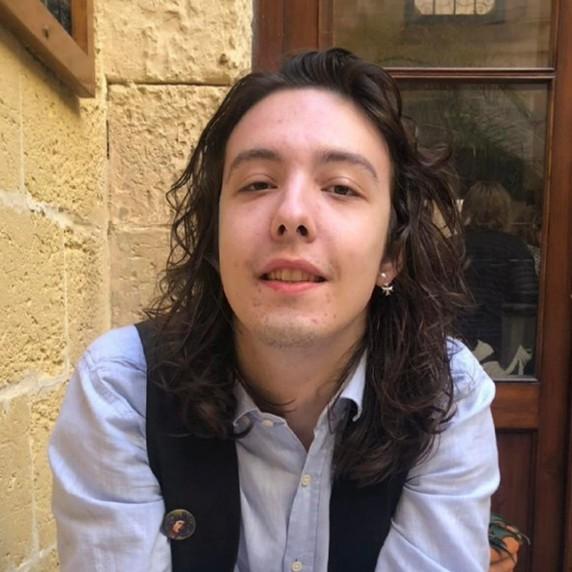
Image above shows Antović at a café in Mdina, Malta. Photo by Uroš Lekić.
TEA: Why did you choose to study archaeology? What else did you consider?
V. Antović: Since elementary school, I have been thinking about my future profession. In last year of high school I considered many different fields, from astrophysics and chemistry, philosophy, anthropology, oriental languages to comparative literature and of course, archaeology. I decided to start my academic journey in archaeology because I have always been fascinated by ancient civilizations and mythologies.
TEA: What are you most interested in at the moment?
V. Antović: At the moment I am interested in hermeneutics and the production of archaeological knowledge as well as dialogues between cultures and epochs. I am also researching two quite different topics: the ritual symbolism of West African masks and late medieval European cosmology.
TEA: From what you have learned so far, what is the biggest issue facing archaeology today? What can archaeologists of your generation do to address this issue?
V. Antović: Paradoxically, the wider the field, the narrower the interests of its scientists. I think that the narrowness of perspective is the biggest problem for a large part of the archaeological community. It is necessary to have a broader view and stop fetishizing the materials we deal with. Archaeologists of the new generation have an obligation to educate themselves in as many fields as possible.
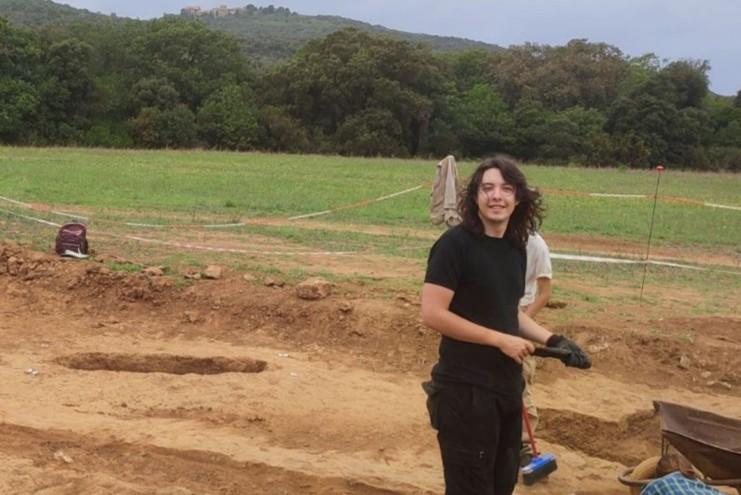
Antović at the excavation of the Etruscan necropolis in the Baratti and Populonia Archaeological Park, Piombino, Italy. Photo by Uroš Lekić.
TEA: What archaeology literature are you reading right now?
V. Antović: Apart from literature on medieval Serbia for my exams, I have recently read Christopher Tilley’s Metaphor and Material Culture. It is a very interesting and important book for those interested in archeological epistemology and semiotics.
TEA: If you could have a conversation with any archaeologist, living or dead, who would it be, and what topic would you choose? Why?
V. Antović: I would probably choose to have a discussion with French polymath scholar, Victor Segalen. Mostly because of his erudition and adventurous life, and also for his ideas on exoticism. I don’t think I would have a specific topic in mind, but we would definitely talk about Han China, Polynesian shamanism, the philosophy of culture and otherness, Gaugin and Rimbaud, and most importantly – poetry. The reason for choosing him is that I feel we have similar sensibilities. His lyrical, poetic perspective on life and culture and his love for the mysterious and alien are really inspiring to me.
TEA: If you could go back in time, would you go? Where, when, and why?
V. Antović: If we neglect the physical consequences of time travel, I would go without hesitation. Unfortunately, I do not have one specific place or time. I would like to visit the great lost libraries of the ancient world in Alexandria, Nineveh, Ugarit, Nalanda, Mo Gao, etc. in their heyday. There I would be able to see what great and interesting books and ideas we have lost forever.
TEA: What is the most important thing you have learned from studying archaeology?
V. Antović: Three years of studying archeology has taught me to feel time, as a cultural factor, much more deeply. Also, to look at human nature from multiple perspectives and to admit to myself some things that I didn't want to acknowledge previously.
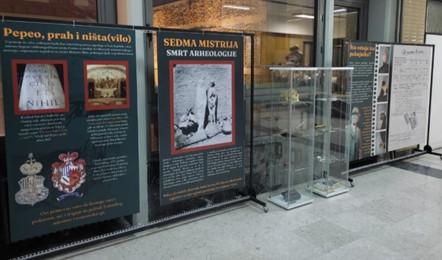
Vukić’s work (second on the left) Sedma mistrija: Smrt arheologije (‘The Seventh Shawl: The Death of Archeology’) at the students’ exhibition Ashes, dust and nothing(ness) as a part of the Center for Theoretical Archaeology conference entitled The Archaeology of Death, Faculty of Philosophy, Belgrade, Serbia. Photo by Tatjana Cvjetićanin.
TEA: What are your plans after graduating?
V. Antović: I hope to continue my postgraduate studies in history of religion in Belgrade or somewhere else, and to begin my scientific work.
Go back to top