Sara Cura
Interdisciplinary Center for Archaeology and the Evolution of Human Behaviour (ICArEHB), Faro, Portugal
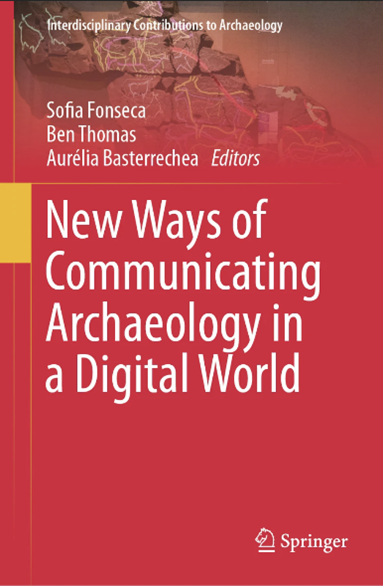
New Ways of Communicating Archaeology in a Digital World, published in 2024 and edited by Sofia Fonseca, Ben Thomas and Aurélia Basterrechea, gathers 11 international case studies around a pressing concern: how to communicate archaeology today in a digital, information-saturated and ethically demanding world.
The volume grew out of EAA sessions in 2018 and 2020 and serves as testimony to a discipline in transition. The COVID-19 pandemic, central to many contributions, accelerated transformations that continue to shape the field, while new challenges — most notably the rise of AI — now redefine communication in 2025. Platforms which were once crucial, such as Skype or Twitter, are already obsolete or problematic, reminding us of the extraordinary pace of change.
Though written largely in 2022, the book remains essential reading. It documents a moment of experimentation and adaptation, while also providing a foundation for current debates on ethics, accessibility, and digital engagement.
The editors establish a practical approach from the outset (Chapter 1). Communication is presented not as afterthought or mere dissemination, but as an integral part of archaeological practice. This is critical: too often research circulates only within academia, struggling to engage museum visitors, local communities, students, or citizens at large.
What makes the book distinctive is its focus on concrete examples. Each chapter functions as both reflection and manual of good practice. In this way, the volume demonstrates that communication is essential if archaeology is to respond to global pressures such as mass tourism, climate change, or disinformation. The digital emerges not as fashion, but as a tool of democratization and inclusion.
The ONLAAH platform (Chapter 2), presented by Sofia Fonseca and Jörg Linstädter, exemplifies this stance. Conceived as an open education project on African archaeology, it directly addresses contemporary dilemmas such as racism, inequality, disinformation, and climate change. Archaeology provides long-term perspectives on human resilience, but only if communicated effectively. Digital platforms, rather than being ends in themselves, can democratize knowledge and open doors to deeper, in-person encounters.
Several chapters highlight immersive technologies. The Ullastret 3D project (Chapter 3), using engines such as Unity, recreates not just archaeological form but also sensory and emotional contexts, making sites accessible to children, people with reduced mobility, and wider publics. Similarly, Ancestors: Stories of Atapuerca (Chapter 4) demonstrates how video games can serve as serious tools for teaching archaeology. Unlike some commercial games that exaggerate or speculate, this project integrates scientific content into its very mechanics, treating archaeology as both method and experience.
Raphaëlle Javet’s historical study of Swiss regional press (Chapter 5) reveals persistent clichés about archaeologists and a near silence on preventive archaeology. This is striking given that most archaeology today is preventive. Her findings underline the importance of communication skills for archaeologists working daily with developers, engineers, journalists, and citizens. Without sustained and informed communication, misperceptions will continue to shape public understanding.
Tourism-focused projects also illustrate the strategic role of digital media. In India, Augtraveler (Chapter 6) uses augmented reality to allow virtual visits to fragile sites, balancing protection with accessibility. In Switzerland, a digital archaeotourism initiative (Chapter 9) seeks to integrate archaeology into national tourist narratives, bridging regional and cultural divides and fostering sustainable identity-building.
The Côa Museum offers a further example of successful digital renewal (Chapter 7). Its immersive technologies modernize exhibitions while deepening interpretation of rock art. As the authors write, “the Côa moves, moves us, and moves with us.” This notion of movement aptly mirrors archaeology itself — always in transformation.
The pandemic forced institutions into rapid adaptation. The Archaeological Institute of America (Chapter 8) highlights the danger of replicating face-to-face models online without rethinking format. Digital activities must be autonomous, designed to create context and accessibility. Their insistence that “online is also a place of encounter” is crucial: digital spaces can foster connection and discovery.
Eleni Gizas’ chapter on Corinth (Chapter 10) illustrates this in practice, showing how virtual field trips and online videos can build shared experiences between archaeologists and students of all ages.
One of the book’s most theoretical contributions explores links between architecture and archaeology (Chapter 11). Both deal with invisibility and hypothesis. By using architectural visualization, the authors propose ways to represent uncertainty, making the process of knowledge production itself visible.
Finally, the HERISTEM project (Chapter 12) demonstrates how the pandemic transformed communication. With physical access impossible, museums became broadcasters and archaeologists’ cultural mediators, while publics shifted from visitors to remote participants. The experience underscored both vulnerability and resilience in archaeological communication.
New Ways of Communicating Archaeology in a Digital World is both repository and manifesto. It documents a pivotal moment when archaeologists experimented with new modes of digital engagement under pandemic pressure, while also outlining principles that remain urgent today.What makes the book distinctive is its refusal to treat digital tools as gimmicks. Instead, it frames communication as an ethical, social and professional responsibility. From open education platforms to immersive museums, from video games to sustainable tourism, the chapters demonstrate the breadth of possibilities when archaeologists take communication seriously. This is a book that deserves wide readership. It inspires us to rethink how archaeology engages society, and to recognize communication as part of the discipline’s very core.
Go back to top