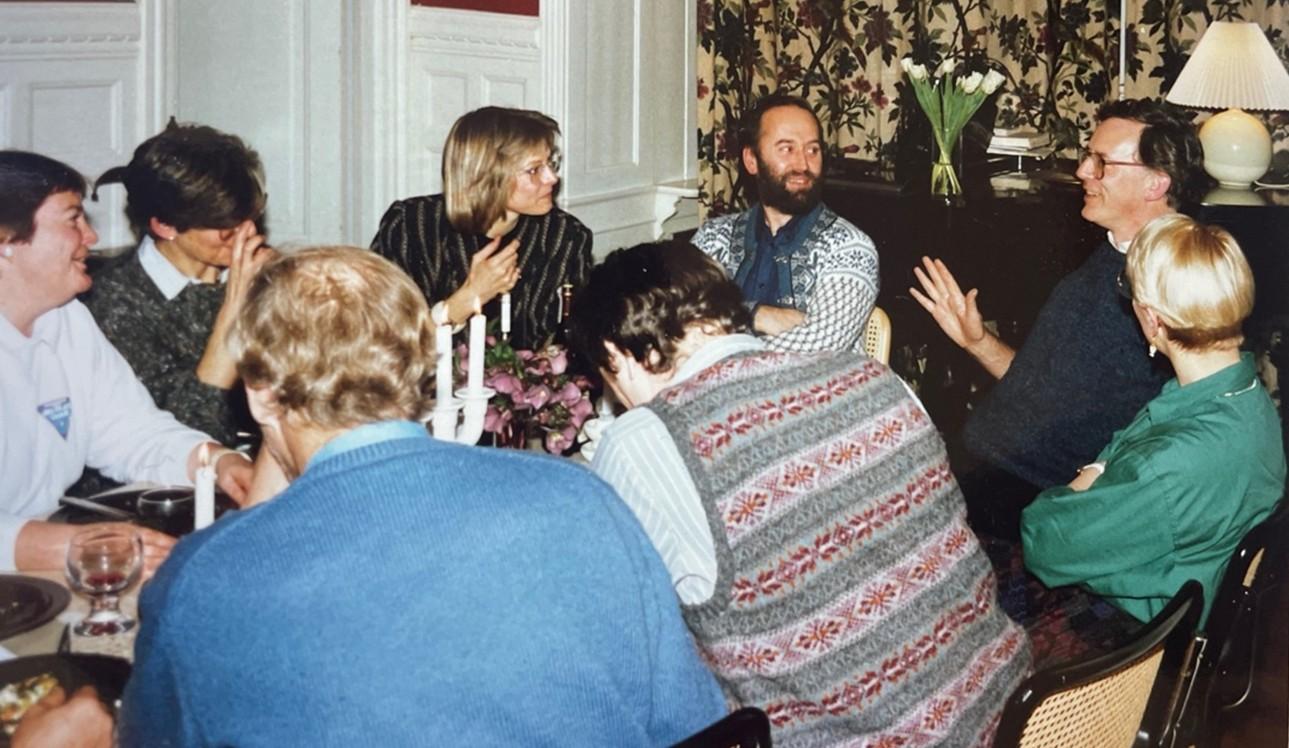
Figure 42. The formative years of conferences and book collaborations in the 1980s: dinner at our home in Copenhagen with from left to right: Sara Champion, Susan Frankenstein Rowlands, Lotte Hedeager, John Collis, Mike Rowlands explaining, unknown, from the back Mogens Trolle Larsen, and Jørgen Jensen. The dinner took place in connection with a conference on Europe in the first Millennium BC, that later appeared as a book.
Professor Michael Rowlands, UCL, died on the 19th of July 2025 after a rapid, incurable cancer. With his death an intellectual and human giant left us, and I lost a lifelong friend and inspiration. Mike and I contributed to several joint undertakings, one of them the formation of the European Association of Archaeologist (EAA) and our still running editorship of the Cambridge Element Series on Critical Heritage Studies.
Born in 1944, and taking his PhD in 1973 on Bronze Age hoards, he soon became dissatisfied with archaeology and turned to anthropology, where together with Jonathan Friedman he produced a groundbreaking paper: ‘Notes towards an epigenetic model of the evolution of ‘civilization’’ in The evolution of social systems : proceedings of a meeting of the Research Seminar in Archaeology and Related Subjects held at the Institute of Archaeology, London University, published in 1977. The inspiration for this was a research seminar started by Jonathan Friedman in Copenhagen in 1975, which focused on ‘Local and Global systems and Social Evolution’. It was during this seminar that I met Mike. The article and the seminar changed my theoretical position forever, and a friendship started with Mike that only came to an end with his passing. This friendship also came to include our families, and from now on there would be dinners and overnight stays whenever one of us were in London, Copenhagen and later Gothenburg. See Figure 42. This was a time from the late 1970s and during the early 1980s where we developed a theoretical position that stood out by being neither processual nor post-processual. It materialised in books like Centre and Periphery in the Ancient World (Rowlands, Kristiansen and Larsen 1987). In 1998 we published jointly: Social Transformations in Archaeology. Global and Local Perspectives, with Routledge – the same year my own Europe before History came out. I believe our theoretical position with its stress on materialism and Marxist approaches wedded to World System Theory became one among several other inspirations behind what later became known as the material turn in archaeology, anthropology, and the humanities more broadly (e.g. the handbook of material culture from 2006 with Mike as co-editor).
Formation of the EAA
When I wanted to start a Journal of European Archaeology in 1988, together with a small, dedicated group, it was natural that I called upon Mike. But we were turned down by all major publishers. Mike set up a meeting with Marion Berghahn. Her first question to us was whether we had an association behind the journal. We looked at each other and said, yes of course this is what we must do! It was late 1989 or early 1990, the Berlin wall had fallen and with it the collapse of Soviet control of eastern Europe. We acknowledged this in the first issue of the journal’s editorial: However, the events in Europe since 1989 are creating a new climate which looks beyond national frontiers and which involves new generations of archaeologists. Across Europe there is an awakening and freshening of archaeological debate about archaeological methods, interpretations, issues, and theories.
Now followed the formation of a new, bigger founding group. This included members from former eastern Europe and Russia, and a student representative from Poland, Arek Marciniak. Most of those first early meetings were held in Paris, but one memorable meeting was organised by Evzen Neustupny in Prague, from where I took a family photo of the first unofficial EAA board. See Figure 43.
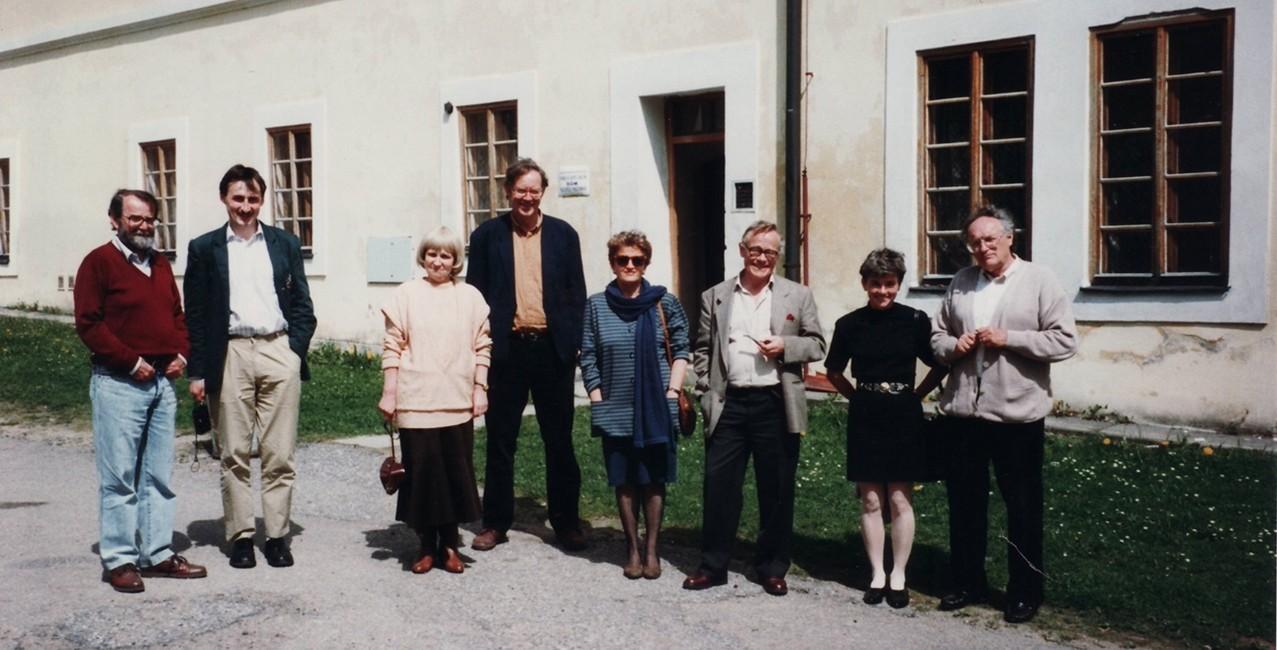
Figure 43. The first EAA board at meeting in Prague. From left to right Evzen Neustupny, Arek Marciniak, Ilze Lose, Michael Rowlands, Anna Maria Bietti Sestieri, Henry Cleere, Maribel Martinez-Navarette, and Bogdan Brukner.
We held the inaugural EAA meeting in Ljubljana in September 22–25, 1994. An opening speech was given by Colin Renfrew. That speech was later published in the second issue of the Journal of European Archaeology, together with a paper by Mike titled “Why do we Need an Association of European Archaeologists?”
In 1990 I started a fieldwork project in Thy, northwestern Jutland, an area rich in Bronze Age barrows and settlements. The aim was to test on the ground some of the interpretations from our books. And of course I invited Mike, who brought also as his assistant, Nick Thorpe, in addition to students. From the US came Timothy Earle with students, and locally my old friend Jens Henrik Bech represented the museum. See Figure 44. We applied new field walking methods as well as new water sieving of excavated soils, and pollen analyses were carried out. Several PhDs were produced, as well as publications (listed in Organising Bronze Age Societies, Cambridge 2010).
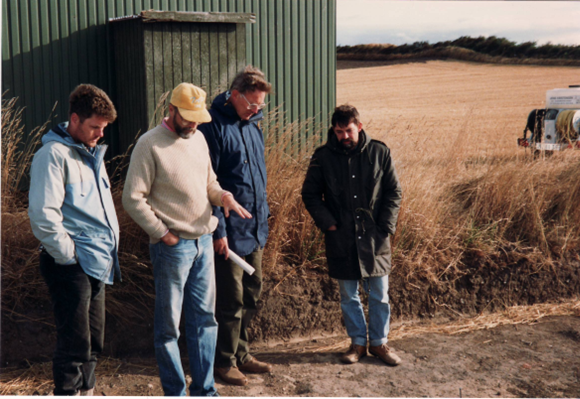
Figure 44. The Thy team inspecting an archaeological feature. From left to right: Nick Thorpe, Tim Earle, Mike Rowlands, and Jens Henrik Bech, early 1990s.
However, after the first few years Mike started a new project in Cameroon that demanded all his attention. In 2011 Mike became visiting professor at CHS, Critical Heritage Studies in Gothenburg. It would later transform into CCHS Centre for Critical Heritage Studies - formal collaboration between GU and UCL (2016-2022). See Figure 45. In addition to delivering a series of highly inspiring lectures where he compared the role of archaeological heritage and museums in Africa and China, he took part in a workshop that inspired a new thematic organisation of our centre, which was to last. In addition, we started closer collaboration in the field of critical heritage studies between GU and UCL and ended up formulating a joint project that was financed from the University of Gothenburg for the period 2016-2022. The project initiated a period of increasingly closer collaboration between our departments that has lasted to this day.
As an important part of the CHSS, we started a new Element series at Cambridge University press, with Mike and I as senior editors. To date, the series has produced around 20 books. As a recognition of Mike’s significant contribution to the development and international expansion of critical heritage research at Gothenburg University he received an honorary doctorate title in 2014.

Figure 45. CCHS meeting at UCL 2016. Back row from the left: Dean Sully, Rodney Harrison, Beverley Butler, Michael Rowlands. Middle row from the left: Felipe Criado-Boado, Anna Bohlin, Clare Melhuish, Alda Terracciano, Anne Gilliland, Niclas Hagen, Staffan Appelgren. Front row from the left: Kristian Kristiansen, Henric Benesch, Astrid von Rosen. Photo by Jenny Högström Berntson.
Mike’s legacy is just as much the intellectual inspiration he gave to so many students and colleagues in Europe, Africa and China, as it is books and wide-reaching articles of lasting significance. Mike was never boring. He was always articulate, inviting debate, and with a huge frame of reference both theoretically and empirically. He could be frank, but always in a civilised and friendly way. A truly learned and theoretically informed polyhistor, of which there are not many around. But if you insist on a global perspective, you must also do your readings, and Mike always had piles of new interesting books on his desk. He lived as he taught: a thoroughly intellectual life. Lecturing and discussing was his lifeblood. Popularisation was not his field; he was always in search of new insights and critical reformulations of established truths. This mindset is clearly illustrated in his most recent book with Stephan Feuchtwang, Civilisation Recast (2019).
How do you say goodbye? We corresponded until two months before Mike’s death, both about his cancer treatment and finding reviewers to our Critical Heritage Element book manuscripts, trying to keep life going. As much as I mourn Mike’s too early death, I remain deeply grateful for the lifelong inspiration I received from our friendship. What more can you ask for when science and friendship merge into a lifelong series of intellectual interactions and collaborations?
Kristian Kristiansen
University of Gothenbug
Go back to top